Back in early 2017, I had the incredible opportunity to participate in MIT’s 6.S094: Deep Learning for Self-Driving Cars competition—DeepTraffic. Hosted via the official MIT DeepTraffic Simulator, it was an exhilarating experience that marked a significant milestone in my journey with AI and autonomous driving technology.
This competition proved to be the ultimate catalyst for my tech career: it earned me a tuition waiver for the Udacity Self-Driving Car Engineer Nanodegree, put my social handle on the map, and eventually led to NVIDIA AI following my Instagram account.
Leaderboard Achievements
| DeepTraffic 1.0 Leaderboard | DeepTraffic 1.1 Leaderboard |
|---|---|
 |  |
| View Full-Res Screenshot ↗ | View Full-Res Screenshot ↗ |
Achieving #1 on DeepTraffic 1.0 & 1.1
In January 2017, after countless hours of hyperparameter tuning, model iteration, and deep reinforcement learning experiments, I managed to reach the #1 spot on the DeepTraffic 1.0 leaderboard under the username Instagram: Jorcus96 with a speed score of 75.38 MPH.
My #1 rank under instagram:jorcus96 was even captured in third-party write-ups and repositories at the time, such as Jason Salas’s Medium article on beating DeepTraffic and pranz24’s MIT-DeepTraffic-1.1 GitHub repository screenshot. Additionally, other top competitors from the community who caught up after months later , such as second-place winner Alireza Kohani, also shared their journeys and strategies in their MIT DeepTraffic 2nd Place Write-up where you can see my name in the leaderboard as well.
Just a month later, in February 2017, MIT released DeepTraffic 1.1, opening the competition to participants worldwide beyond MIT-registered students. The competition was even fiercer, but my optimized RL strategies paid off once again—I reclaimed the #1 spot on the DeepTraffic 1.1 leaderboard with an improved score of 75.82 MPH!
While waiting to hear back about the rewards, I pushed my model even further and achieved another top rank after hitting an even higher score of 76.16 MPH in February. After reaching that milestone, I decided to wrap up my work on the competition. Eventually, other participants surpassed that score, but my result remained in the Top 3 for nearly a year until the online competition was officially taken down from the website. Fortunately, the leaderboard was preserved on the Web Archive (captured on October 18, 2017), where my name is still visible.
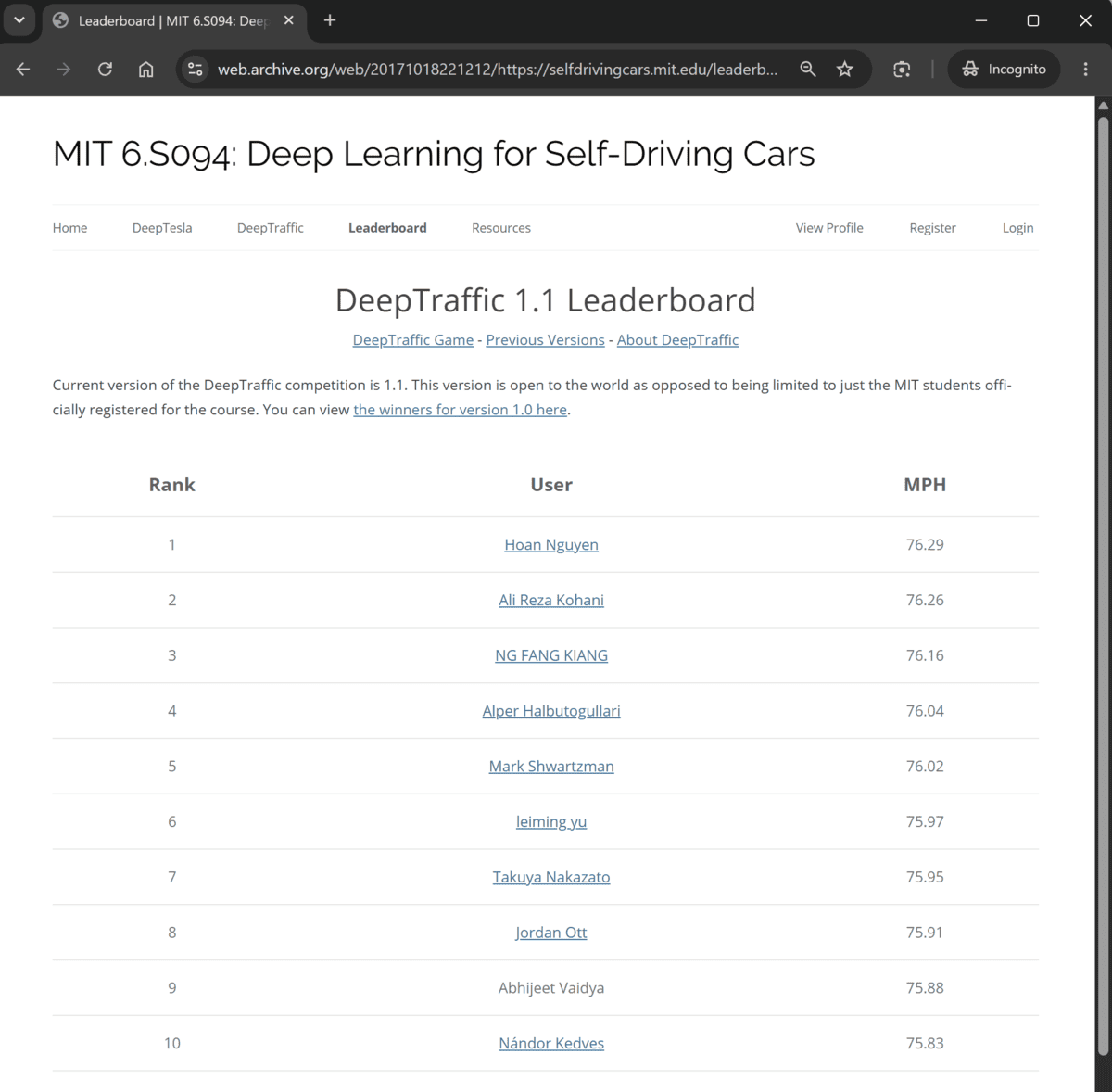
- Web Archive snapshot of the DeepTraffic 1.1 Leaderboard (saved October 18, 2017) showing NG FANG KIANG at Rank 3 with a score of 76.16 MPH.
MIT DeepTraffic Lecture & Competition Overview
To understand the core concepts behind DeepTraffic and how deep reinforcement learning is applied to motion planning, you can watch the official MIT 6.S094 lecture video below:
For further details on the underlying simulation engine, deep Q-learning environment, and parameters, check out the official MIT DeepTraffic GitHub repository.
Years later, Lex Fridman and his co-authors formally published the research paper “DeepTraffic: Crowdsourced Hyperparameter Tuning of Deep Reinforcement Learning Systems for Multi-Agent Dense Traffic Navigation” (arXiv:1801.02805), detailing how thousands of participants crowdsourced the search space for RL agent parameters in dense traffic simulations.
Turning Achievements into Opportunities
After securing the top rank on both leaderboards, I took screenshots of my rankings and shared them with potential sponsors to showcase my passion and technical competence in self-driving technology.
That effort yielded an unbelievable result: I was awarded a one-term tuition waiver for the Udacity Self-Driving Car Engineer Nanodegree—generously provided by the CEO of a prominent autonomous driving startup and former VP of Udacity!
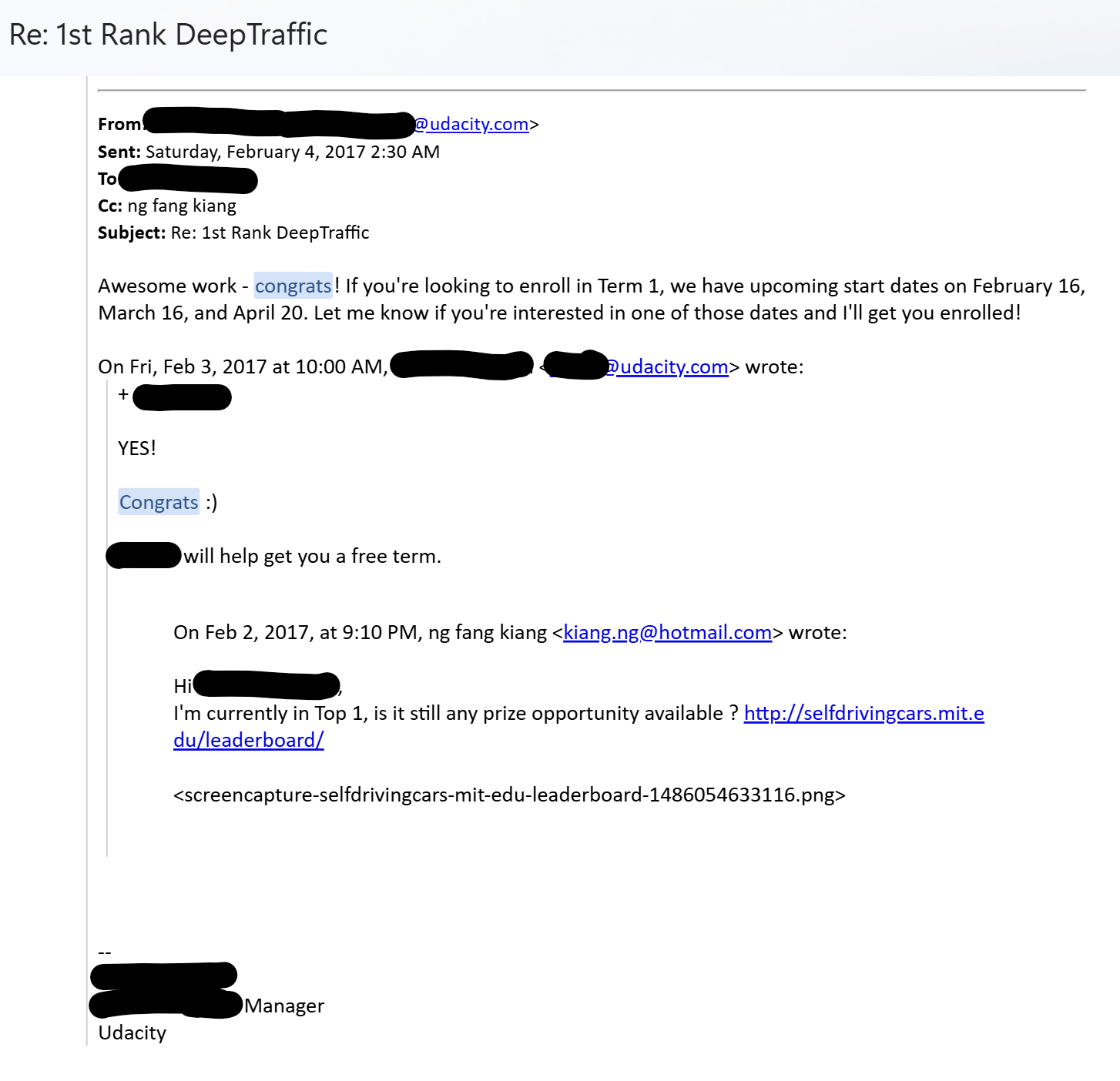
This scholarship opened the doors to the hardest online course I ever took. Little did I know that branding my username as Instagram: Jorcus96 on the MIT leaderboard would also spark a chain reaction on social media, leading to NVIDIA AI following me on Instagram shortly after!
Key Takeaways
Looking back, this experience taught me two important lessons:
Persistence in AI/RL Experiments: Fine-tuning reinforcement learning models requires patience, systematic trial-and-error, and deep understanding of agent-environment interactions.
Showcasing Your Work Matters: Achieving something is great, but actively sharing your achievements, branding your work, and reaching out to supporters/sponsors can unlock opportunities you might never have imagined.
Thank you to MIT for hosting such an awesome benchmark competition and to everyone who supported me throughout this journey!
References & Academic Publications
- Research Paper: Lex Fridman, Jack Terwilliger, & Benedikt Jenik. “DeepTraffic: Crowdsourced Hyperparameter Tuning of Deep Reinforcement Learning Systems for Multi-Agent Dense Traffic Navigation” (arXiv:1801.02805).
- Official Competition Code: MIT DeepTraffic Open Source Repository on GitHub
- DeepTraffic 1.0 Verification: Leaderboard Proof Screenshot (GitHub Repository)
- DeepTraffic 1.1 Verification: Leaderboard Proof Screenshot (GitHub Repository)
- Web Archive Leaderboard: MIT 6.S094 DeepTraffic 1.1 Archived Leaderboard (Oct 18, 2017) (showing NG FANG KIANG at Rank 3 with 76.16 MPH nearly a year later)
- Third-Party Community Write-up: My Attempt at Beating DeepTraffic by Jason Salas (featuring
instagram:jorcus96at #1 on the leaderboard screenshot) - Third-Party GitHub Repository: pranz24’s MIT-DeepTraffic-1.1 Repository (capturing
jorcus96at #1 on the leaderboard) - Community Achievement: Alireza Kohani’s 2nd Place Journey & Design Portfolio (detailing the 2nd place strategy in the MIT 6.S094 DeepTraffic challenge)