Looking back a decade to 2016, I made a decision that looked to everyone around me like career suicide: fresh out of a Diploma in Business Studies, I walked away from the conventional university conveyor belt and refused to settle into a standard 9-to-5 desk job.
Instead, I locked myself in my bedroom, turned on my monitor, and went all-in on full-time, self-directed learning through Massive Open Online Courses (MOOCs).
Today, self-directed upskilling, remote engineering, and querying AI for guidance are accepted as second nature—a shift that aligns closely with what I later reflected on when looking back at my 2021 tech predictions. But in 2016, choosing online education over a traditional degree was widely perceived as a punchline. To friends, relatives, and neighbors, sitting at a desk all day staring at terminal windows and video lectures wasn’t “studying”—it was an excuse to avoid adult responsibilities, a cover for unemployment, and an escape from reality.
This is the unfiltered story of why I chose that lonely, unusual route, why I couldn’t accept the default domestic corporate ladder, and how being backed into a corner forced me to build my own future.
1. The Dream: OMSCS and the American Frontier
My original ambition was never to become an isolated recluse; it was sharply defined and pragmatic.
Having realized during my business diploma that my true obsession lay in code, logic, and bleeding-edge computing, I set my sights on Georgia Tech’s Online Master of Science in Computer Science (OMSCS).
My blueprint at the time was clear:
- Enroll in OMSCS to gain rigorous, accredited computer science credentials at a fraction of on-campus tuition costs.
- Work freelance gigs and part-time developer roles to fund my living expenses.
- Use the degree and an accelerated project portfolio as a springboard to transition to the United States and work at the frontier of technology.
I poured myself into coursework on Udacity, edX, and Coursera, searching for a viable path forward. Back in 2016, Udacity hosted Georgia Tech’s official OMSCS curriculum directly on its platform, allowing anyone with the grit to enroll and audit the actual graduate-level lectures for free. I didn’t wait for a formal admission letter to start proving myself—I jumped right in, enrolled in multiple OMSCS courses through Udacity, and tackled the graduate coursework head-on.
This wasn’t just passive learning; it was a relentless search for a door into a world I was determined to join. In August 2016, I sent a hopeful, almost pleading email to Udacity’s support, asking if my Nanodegree and self-study could serve as a bridge to formally matriculate into Georgia Tech’s OMSCS program without an undergraduate Computer Science degree.
“I seriously want to be a part of student in OMSCS. I hope it’s possible!!” — My email to Udacity Support, August 2016.
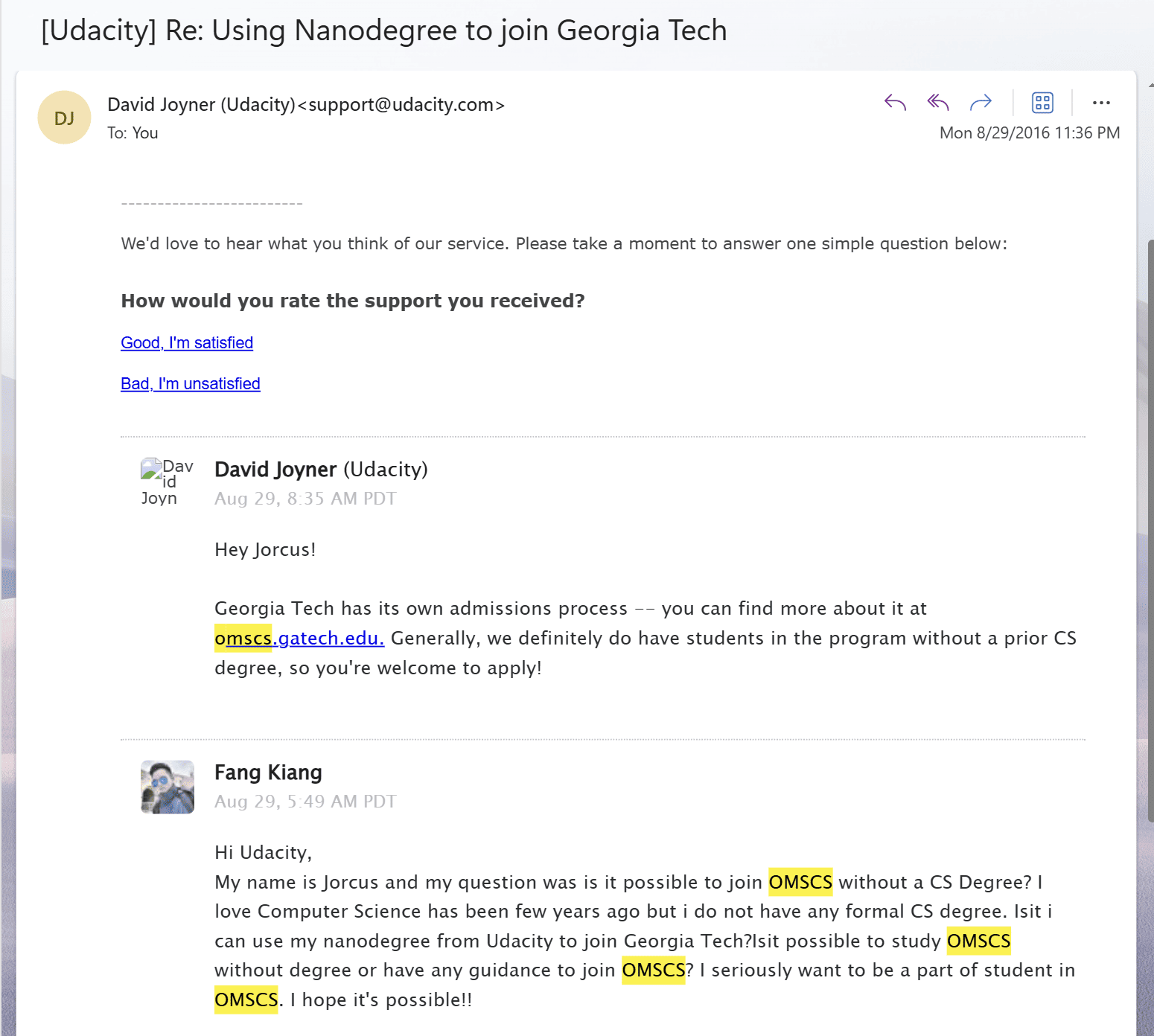
The reply I received from David Joyner at Udacity was the exact spark I was looking for. He confirmed that Georgia Tech did, in fact, accept applicants without a prior CS degree and encouraged me to apply. That email was far more than a customer support ticket; it was a signal that the path, however unconventional, was genuinely possible.
This external validation grew even stronger when I connected with another internal team member at Udacity. Having noticed in my Instagram bio that my ultimate goal was to pursue a Master’s degree, he personally offered to write me a recommendation letter for OMSCS and even wanted to feature my story on Udacity’s official website. Although family circumstances ultimately prevented me from formally enrolling, that connection remained a meaningful milestone—years later, he went on to join Apple, while I forged my own path as an entrepreneur.
I had the passion. I had the raw work ethic. I had early external validation from people inside the industry.
Yet, I was entirely powerless against domestic reality.
2. Breaking the Clock: Why I Refused to Wait for Semesters
Beyond my specific goal of getting into OMSCS, there was another fundamental reason I rejected traditional universities: they are bound by rigid timelines rather than personal velocity.
Conventional degree programs force you to march to the beat of an institutional calendar. Regardless of how fast you grasp the material or how many hours you are willing to pour in, your progress is artificially throttled by semester schedules, credit-hour limits, and bureaucratic pacing.
I didn’t want to spend three to four years waiting for permission to learn the next topic. My goal was simple: achieve the maximum possible output in the shortest possible time.
At the time, Udacity offered a game-changing incentive: a 50% tuition refund for students who completed a Nanodegree early or within a strict timeframe. Because my financial resources were severely limited, this policy aligned my economic survival directly with my hunger for speed:
- Relieving Financial Pressure: Cutting my tuition costs in half meant I could stretch every hard-earned dollar twice as far.
- Compounding My Output: The faster I mastered the curriculum and shipped projects, the less I paid—and the sooner I could roll those savings into the next specialization.
Driven by both financial necessity and sheer obsession, I treated every course like a high-stakes sprint. By removing the artificial speed limits of a traditional classroom, I went on to complete far more rigorous coursework in a fraction of the time it would take a conventional student.
3. Anchored by Finances and a Controlling Environment
Even with the 50% tuition refunds keeping my self-study afloat, ambition means very little when your immediate environment is actively working against it.
Coming from a modest financial background, every dollar still had to be accounted for. Worse than the financial ceiling, however, was living in an unsupportive and deeply controlling family dynamic. To them, the tech industry was an alien concept, and online learning was an illegitimate pursuit.
The people around me were products of an analog, risk-averse mindset. They didn’t research emerging technologies, search Google to verify facts, or grasp where global software engineering was heading. If society dictated that success meant taking an entry-level clerk or sales position, deviating from that script was seen as ungrateful and aimless.
Every hour I spent learning linear algebra, writing C++, or training neural networks was met with cold shoulders, skepticism, and persistent pressure to abandon what they called a “pipe dream.”
I desperately wanted to step through the door that the Udacity recommendation and OMSCS had cracked open. But without full financial independence, without familial backing, and bound by responsibilities I could not simply discard, the door slammed shut. As I reflected in At the Peak, But Bound by Ground, reaching your intellectual stride while being physically and financially tethered is a uniquely painful paradox. I could not afford to go abroad. I could not even afford the baseline safety net needed to pursue a formal degree.
4. Why I Refused a Conventional Job in Malaysia
People frequently asked: “If you couldn’t go abroad or afford university, why not just get an ordinary programming or corporate job in Malaysia?”
The candid, uncomfortable answer is that in 2016, the local ecosystem was not structured to nurture or reward high-end technical ambition.
A Severe Ceiling on Meritocracy:
In the domestic market at that time, career progression and compensation were seldom tied directly to technical excellence or problem-solving capability. Advancements were heavily governed by seniority, office politics, and sheer luck. The salary increments were painfully narrow, offering little incentive to push beyond the bare minimum.The Danger of Stagnation:
The technological gap between what was happening at Silicon Valley frontiers (deep learning, autonomous driving, distributed cloud infrastructure) and local enterprise IT was immense. In environments where cutting-edge initiative is treated with indifference, exceptional technical talent inevitably gets dragged down to the baseline. I knew with absolute certainty that if I entered that pipeline, the hunger and sharpness that defined me would be eroded by routine maintenance tasks and corporate inertia.
I knew that once going abroad was off the table, taking a conventional domestic job would seal my fate. If I wanted to maintain a global standard of engineering rigor, I had to construct my own forge.
5. The Crucible of Isolation
When both traditional higher education and domestic employment were off the table, the only path left was forward through the dark.
From late 2016 into 2017, I treated MOOCs not as passive video watching, but as an unforgiving, full-time apprenticeship:
- Fueled by the urgency to hit Udacity’s 50% refund deadlines and maximize my trajectory, I compressed years of learning into months—mapping out a steep technical tree from responsive front-end work and full-stack architecture to mobile development, applied machine learning, and eventually low-level robotics.
- Beyond the OMSCS curriculum on Udacity, I benchmarked myself against the toughest open courses from elite universities—working through Stanford’s CS231n: Convolutional Neural Networks for Visual Recognition from scratch, alongside UC Berkeley’s CS188: Introduction to Artificial Intelligence to build a rock-solid theoretical foundation in search algorithms, reinforcement learning, and computer vision.
- When I was accepted into the inaugural cohorts of Udacity’s Self-Driving Car Engineer Nanodegree alongside engineers from Google, Apple, and Stanford, I didn’t have a CS degree to lean on. It quickly became the hardest online course I ever took. I bought used mathematics textbooks, stayed up until 4:00 AM wrestling with Extended Kalman Filters and Model Predictive Control in C++, and ground through compiler errors in silence.
- In early 2017, that quiet grit culminated in taking #1 on the global leaderboard of MIT’s DeepTraffic competition, earning a tuition scholarship, and later catching the attention of Silicon Valley executives and even seeing NVIDIA AI follow my Instagram.
To the outside world, I was still just a kid locked in his room with no job and no degree. The stigma of “doing online courses” meant enduring years of quiet disrespect from those who equated physical office attendance with worth.
Being viewed as lazy when you are putting in 14-hour days teaching yourself autonomous systems from academic papers is a unique kind of psychological crucible. But it forged in me a level of mental independence that no university lecture hall could ever replicate.
6. The Inevitable Pivot: Forging My Own Path
Eventually, the realization crystallized: no institution was coming to rescue me.
Academia had shut its gates due to finances. Moving overseas was constrained by duty. The local job market could not offer the trajectory I needed.
Left with no viable alternatives, I chose entrepreneurship and independent building.
If nobody was going to give me a seat at the table, I had to build my own table. I began taking freelance development projects, launching digital products, solving real-world client problems, and funding my own survival one commit at a time. Entrepreneurship wasn’t a glamorous branding exercise; it was the only remaining vehicle for autonomy.
Final Thoughts: The Armor Built in the Dark
Looking back a decade later, was it an unusual route? Undoubtedly. Was it painful? Deeply.
Missing out on Georgia Tech, having to turn down international invitations because I couldn’t afford a plane ticket, and bearing the weight of an unsupportive environment left real scars.
Yet, I harbor zero regrets.
Choosing the unusual route stripped away any reliance on credentials, luck, or external approval. It taught me that genuine capability is proven by proof-of-work, not paper pedigrees. Most importantly, it gave me the mental armor to take on any challenge—whether building complex software systems from scratch, venturing into the dark to conquer Fraser’s Hill, or pedaling 300 kilometers solo through pitch-black highways inside 24 hours—knowing that as long as I retain control of my focus and willpower, no ceiling is permanent.