This journey stands as Chapter 2 and the grand finale of my twenties endurance series. It is the direct sequel to my 200 km mountain expedition: Pitch Black Detours and 2,000m+ Climbs: How I Conquered Fraser’s Hill Solo.
“You don’t need carbon fiber or expensive kit to conquer massive distances—just a solid bike, a plan, and the mental grit to push through.”
📌 Prologue: From Fraser’s Hill to the “Graduation Badge”
Every grand ambition is forged in pain and self-discovery.
My first true trial was conquering Fraser’s Hill—a solitary 200 km grind against pitch-black forest backroads, nocturnal livestock roadblocks, and over 2,200 meters of vertical gain. That ride proved a vital truth: mental resilience matters infinitely more than premium gear.
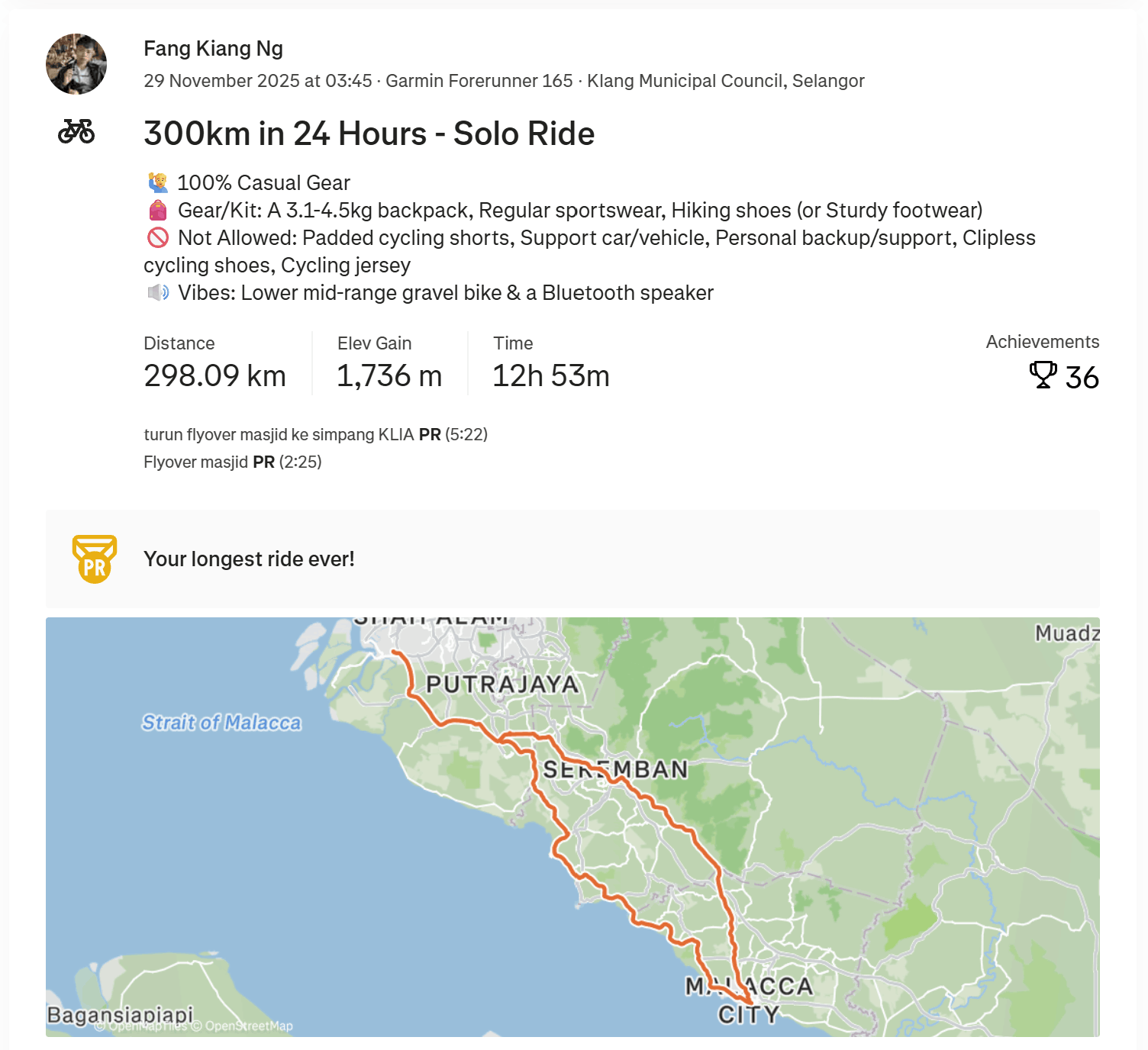
Roughly a year after standing at the clock tower of Fraser’s Hill, with the twilight of my twenties approaching, I knew I needed one final, defining milestone. I wanted to claim an unforgettable “graduation badge” for my 20s: an unsupported, 300-kilometer ultra-endurance loop across Malaysia in under 24 hours.
Claiming this badge took two grueling attempts:
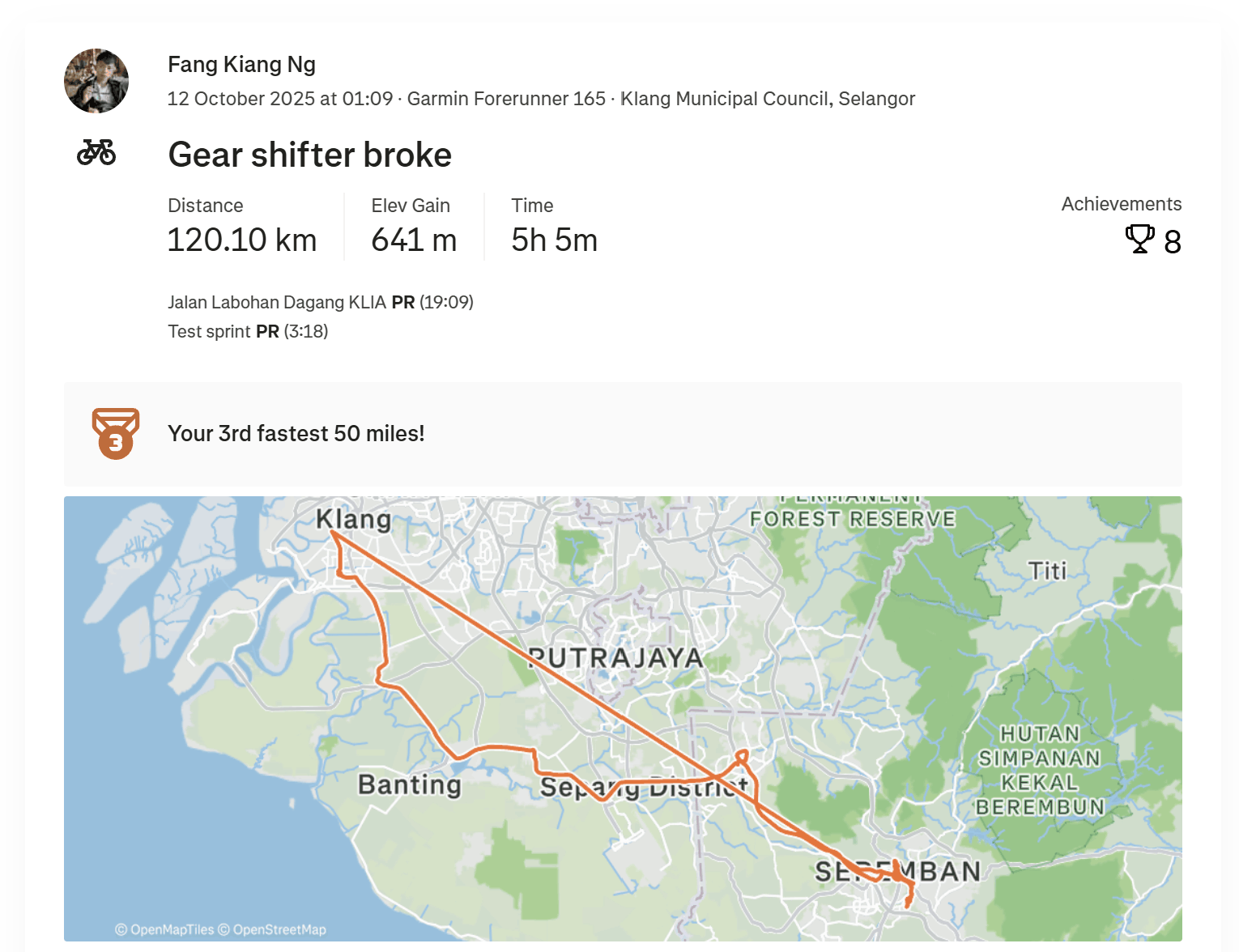
- The First Attempt (Heartbreak): A mechanical failure at Kilometer 120.1 snapped my drivetrain, forcing a bitter DNF on October 12, 2025.
- The Second Attempt (Redemption): Six weeks of rebuilding and mental refocusing culminated on November 29, 2025, where I completed the sub-24h loop in raw, casual gear.
The catch? No $10,000 carbon fiber road bike. No aerodynamic Lycra bibs. No clipless shoes. Zero support crew following in a van with spare wheels and ice packs.
Just me, a lower-mid-range DIY gravel bike, regular casual sportswear, hiking shoes, flat pedals, and a heavy 4 kg backpack weighing down on my spine for nearly a full day.
💥 1. The Failure That Fueled the Ride
Every major physical achievement is built on the ashes of a previous defeat.
Six weeks prior, carrying the confidence of the Fraser’s Hill climb, I was locked into a steady rhythm on my first 300 km attempt. I was flying—until Kilometer 120.1.
With a harsh metallic click, my rear gear shifter snapped. Stranded on a hot roadside with an unshiftable drivetrain after 5 hours and 5 minutes of solid riding, I was forced to retire.
Leaving that route unfinished burned in my mind every single day. I brought the bike home, rebuilt the broken components piece by piece, and waited for my shot at redemption.
This bike wasn’t bought off a showroom floor; I built this gravel bike from scratch, 0-to-1, starting with a bare frame. Every single component, bolt, and cable was hand-selected and customized by me. Because I knew every thread of its geometry, I knew exactly how to fix it when things went wrong. I spent the next six weeks sourcing parts, tuning the shifting index, and prepping for round two.
Mental grit was tested again just seven days before my second attempt. During a 100 km night training session, I rode straight into the fresh scene of a fatal road accident. A victim lay motionless on the asphalt, surrounded by shattered glass and pooling blood.
Passing within inches of that raw tragedy anchored a cold reality into my mind: Malaysian roads at night do not forgive mistakes.
📜 2. Rules of the Challenge: Self-Imposed Hard Mode
To truly isolate mental resilience from equipment advantage, I bound myself to a strict set of self-imposed constraints:
- The Bike: DIY Lower Mid-Range Gravel Bike—heavy, mechanical, custom-built from the frame up, and far from aerodynamic.
- The Attire: 100% Casual Gear. A basic dri-fit shirt, regular athletic shorts (zero padded chamois), and sturdy hiking shoes on flat pedals.
- The Setup (100% Solo & Unsupported):
- A 3.1 kg to 4.5 kg weighted backpack strapped to my shoulders the entire distance.
- Self-Sufficient Mobile Mechanic: That heavy backpack carried an extensive, carefully selected array of repair kits. Because I built the bike myself, I carried the tools to diagnose and repair almost any catastrophic mechanical failure on the fly.
- A small Bluetooth speaker mounted to the handlebar stem for ambient audio.
- Strictly no escort vehicles, no pacing partners, and no roadside support.
📊 3. Route & Key Performance Stats
| Metric | Achievement |
|---|---|
| Date & Start Time | 03:45 AM, Saturday, 29 November 2025 |
| Start Location | Klang Municipal Council (MPK), Selangor, Malaysia |
| Total Distance | 298.09 km |
| Moving Time | 12h 53m 32s |
| Elapsed Time | 23h 17m 26s (Sub-24 Hours Achieved!) |
| Elevation Gain | 1,736 m |
| Average Speed | 23.1 km/h (Max Speed: 53.6 km/h) |
| Energy Output | 6,630 kJ / 143 W Avg Power (7,392 Calories burned) |
[Klang Start] ➔ [Banting] ➔ [Nilai] ➔ [Seremban] ➔ [Alor Gajah] ➔ [Malacca] ➔ [Coastal Route / Lukut] ➔ [Port Dickson] ➔ [Sepang / KLIA Wasteland] ➔ [Finish]
💡 4. Choosing the Hard Road: Equipment vs. Human Will
Modern cycling culture dictates that to ride 300 km, you must spend thousands on ultralight carbon frames, skin-tight aero jerseys, stiff carbon-soled shoes, and thick bib pads. Ultra-distance riders almost always rely on support cars trailing behind with cold water, fresh meals, and spare parts.
But this challenge wasn’t about optimal efficiency; it was about forging the definitive graduation badge of my 20s.
Your twenties are a unique, fleeting chapter in life—a window of time where your time, energy, and freedom belong entirely to you. When I completed the Fraser’s Hill climb a year earlier, I realized physical capability is secondary to psychological grit. Once you transition into your thirties, life naturally shifts, and family and career responsibilities rightfully become the priority.
Before stepping into that next chapter, I wanted to take absolute ownership of my youth, push my boundaries to their absolute perimeter, and achieve something extraordinary.
I wanted to build a story worth telling. Decades from now, I want to look my future children in the eye and tell them what was possible when their parent refused to back down after failure.
Choosing a heavy 4 kg backpack meant my shoulders, lower back, and sit bones bore relentless downward force for 23 straight hours. Every watt saved by aerodynamic gear was a watt I had to produce manually through pure, unadulterated grit.
🚴♂️ 5. The Journey: Darkness, Floods, Crashes, and Wastelands
🕒 03:45 AM — Rolling into the Unknown
Leaving the Klang Municipal Council under the dim glow of orange streetlights, the night air was heavy with humidity. The route cut south toward the quiet, wide avenues of Putrajaya before weaving toward Seremban and the historic coastal approaches of Malacca.
🌊 Battling Active Flood Zones in Malacca
What the weather app didn’t capture was that parts of Malacca were actively submerged under severe flash floods. Emergency relief centers (PPS) were opening up across multiple districts.
As I pushed into low-lying rural stretches, heavy rain clouds hung low, turning the air ice-cold. Spray from passing lorries cut my visibility, and murky floodwaters encroached onto the asphalt.
Navigating submerged road edges where potholes were completely hidden required hyper-vigilance. One wrong line meant a ruined rim or a violent plunge into a roadside canal. Knowing a single heavy downpour could trap me in a flooded dead-end added intense mental friction to every pedal stroke.

🏁 Crossing the 200 km Milestone (Port Dickson)
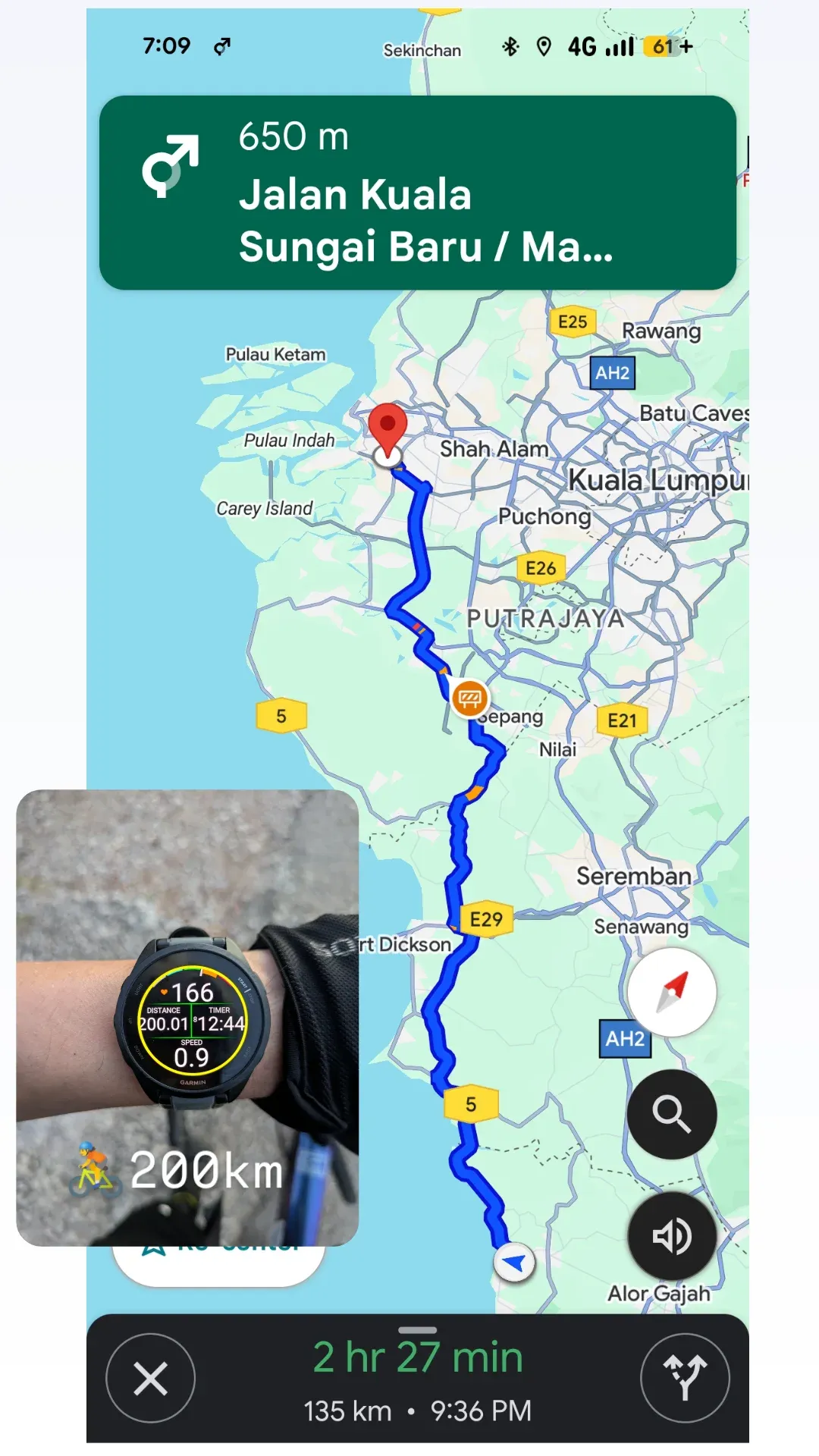
By the time I crossed the 200 km mark—matching the entire distance of the Fraser’s Hill expedition—exhaustion was biting deep.
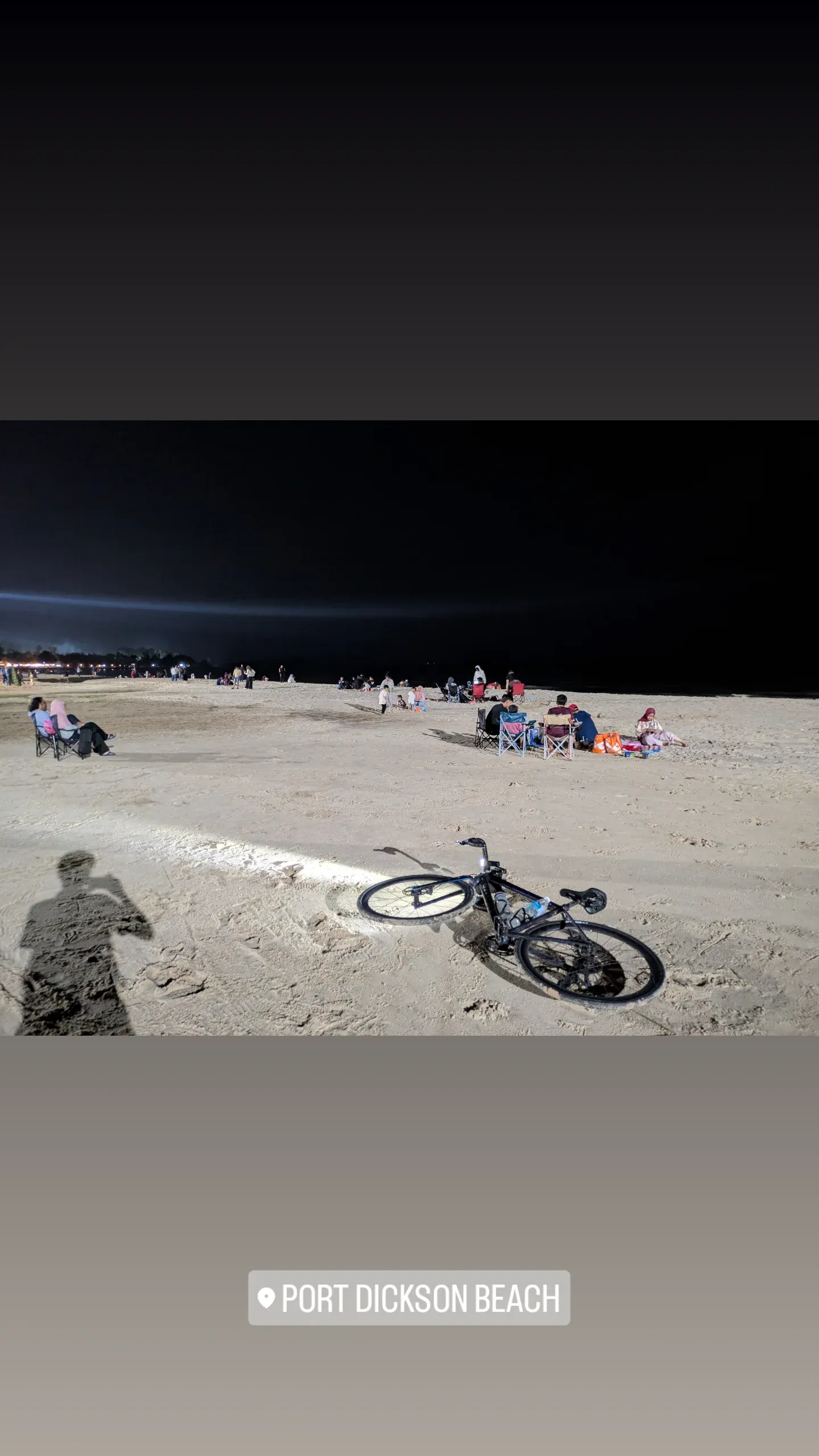
But as the route led back along the coastal stretch toward Port Dickson, taking a brief breather on the beach gave me a moment to recalibrate and steady my mind for the darkest night section ahead.
⚠️ Blinding High Beams, a Sudden Crash, and Pitch Darkness
Midway through the night, while navigating a rural road with zero street lamps, disaster struck.
A vehicle approached from behind at high speed, repeatedly flashing blinding high beams. Feeling like it was right on my tail, I swerved slightly toward the shoulder to yield. In an instant, my front tire dropped into a jagged, hidden pothole.
The handlebars twisted violently out of my grip. I went flying over the bars, slamming hard onto the pavement.
The car didn’t stop. Its taillights vanished into the distance, leaving me lying alone in dead silence on an unlit road. Dazed and bleeding from minor abrasions, I checked the bike under the faint glow of my headlamp. The front wheel had taken a direct impact and was jammed sideways against the fork frame; the mechanical shifting was severely misaligned.
Standing alone in the total dark, my heart pounding with adrenaline, I wrestled the front wheel back into place, re-trued it with manual leverage, adjusted the brake calipers, and clipped back in. After recovering from the heartbreak of attempt one, quitting here was never an option.
🌌 The 40 km Wasteland: Lukut to Sepang (12:00 AM – 03:00 AM)
The darkest mental zone occurred between midnight and 3:00 AM along the 40-kilometer stretch connecting Lukut to Sepang and KLIA.
Over 95% of this corridor had no operational streetlights. Dense, overgrown oil palm trees and the jungle canopy absorbed what little moonlight existed. Petrol stations were locked up tight, offering no lights or water.
To keep mind-numbing fatigue from taking over, I cranked the volume on my mounted Bluetooth speaker, letting music punch through the heavy silence. The road felt like an apocalyptic wasteland: across the entire 300 km journey, I counted between 30 to 50 dead animal carcasses strewn across the road—stray dogs, cats, massive monitor lizards, and at one point, three full-sized cows lying dead on a single stretch of shoulder.
🔥 6. The Ultimate Crucible: Hidden Agony & Mental Strain
If anyone were to ask me what the single hardest part of those 23 hours was, the answer wouldn’t be physical exhaustion—it was the extreme physical torment combined with a state of hyper-vigilant mental strain.
Forgoing professional cycling bibs proved to be the most brutal sacrifice of the entire challenge. Without a padded chamois to cushion the impact, hundreds of thousands of pedal strokes and relentless friction reduced the skin on my inner thighs to raw, inflamed agony. By the second half of the ride, every single revolution felt like a dull blade sawing through open flesh. That deep, bone-chilling pain forced me to stop every few minutes, leaning over my handlebars by the roadside to let the searing burn fade just enough before gritting my teeth and mounting the saddle once more.
Yet, even more punishing than the physical torture was the suffocating mental exhaustion.
Along dozens of kilometers of unlit roads, the pitch-black night swallowed the highway whole. I had to stretch my focus to its absolute limit, unable to relax my eyes for even a fraction of a second. At any moment, a deep, bone-breaking pothole could appear out of nowhere, stray dogs or wildlife could dart across the lane, or a massive animal carcass might lie sprawled across the asphalt.
In the cold and dark, I wasn’t just fighting fatigue—I was playing a high-stakes game against potential disaster. Maintaining that level of intense concentration under constant high pressure drained my mental bandwidth far faster than muscle fatigue ever could.
⚠️ A Crucial Reality Check: Why I Strictly Advise Against This Setup
Before anyone considers grabbing a gym shirt, flat pedals, and an unsupported backpack for a 300 km ultra-distance ride: do not attempt this.
Forgoing cycling bibs and riding completely unsupported was not a casual whim—it was an extreme, calculated threshold test built on years of extreme conditioning. My physical baseline before taking on this challenge was far from ordinary:
- 15,000+ km of Solo Ride Heritage: Over the preceding two years alone, I logged more than 5,000 km of weighted solo rides, building an accumulated foundation of over 15,000 km in solo cycling records.
- Daily Unpadded Conditioning: I spent years training daily without padded bibs, gradually hardening my body to relentless saddle pressure and friction.
- Martial Arts Foundation & Pain Threshold: Years of disciplined martial arts training forged the core stability, mental composure, and high tolerance for physical suffering required to endure prolonged trauma.
- Peak Physical Conditioning: Having shattered personal fitness test records in the gym, my overall conditioning and endurance capacity were operating near pro-athlete thresholds.
- Mastery of Mechanical Self-Sufficiency: Going unsupported meant I had to be my own mechanic, pit crew, and rescue team. Because I built this bike from scratch, I knew every single bolt and cable tension. I carried a comprehensive, heavy array of specialized repair kits and tools. In the middle of the night, on a pitch-black roadside, you cannot google a solution or wait for help; you must possess the diagnostic skills and muscle memory to rebuild, true, and realign your drivetrain on the fly after a crash.
- Relentless and Exhaustive Preparation: The sheer volume of pre-ride planning was monumental. From plotting water stops that remained open past midnight, to analyzing elevation profiles, calculating battery burn rates for lights, and preparing contingency routes for flood zones—the mental preparation took weeks of meticulous drafting.
Even with this baseline, riding 300 km in casual clothes nearly broke me. For 99.9% of riders, doing this without a padded chamois risks permanent soft-tissue nerve compression, debilitating saddle sores, and severe skin infections.
Furthermore, riding unsupported on Malaysian roads at night without an escort crew is extraordinarily dangerous. Between sudden flash floods, unlit potholes, roaming packs of stray dogs, heavy freight traffic, and unmonitored mechanical or physical crashes, a single mistake can be fatal when you have no trailing car to pull you out of danger.
Padded bibs, aerodynamic gear, and support vehicles were invented for a reason: your safety. Respect the distance, equip yourself properly, and never sacrifice fundamental safety protocols unless you have spent years systematically conditioning your body and mind for the punishment.
🚉 7. The Chaotic Aftermath & Logistical Survival
Crossing the 298 km mark at 23 hours and 17 minutes, I officially completed the challenge within the 24-hour limit. The graduation badge of my twenties was finally secured.
I was exhausted, filthy, and covered in road grime—yet surging on post-ride adrenaline. Instead of slumping onto the curb, I decided to celebrate with a bizarre change of pace: pushing my dusty bike straight into KLIA2 to shop around and grab food among stunned airport travelers.
The final logistical stretch proved to be its own mini-adventure:
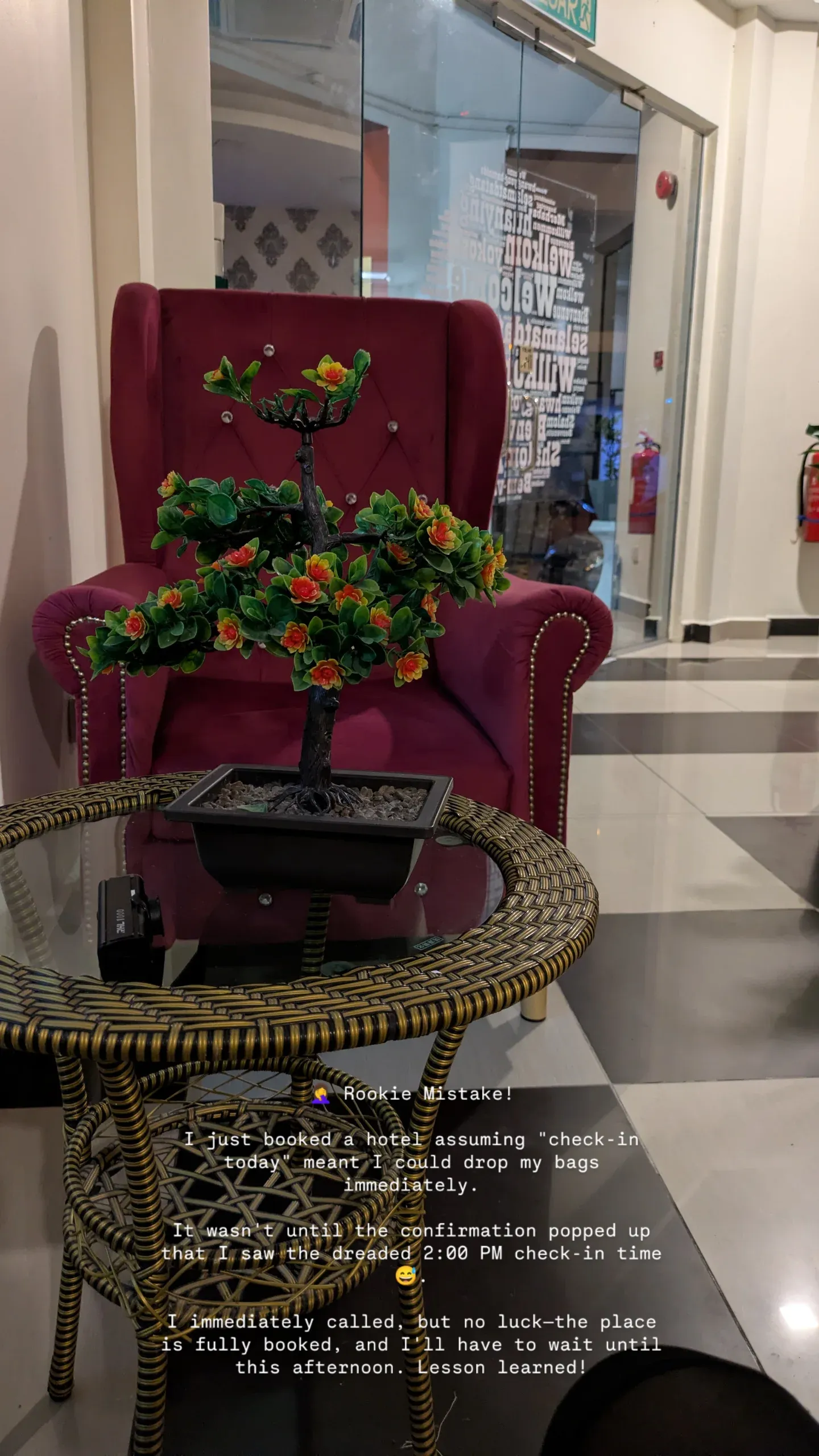
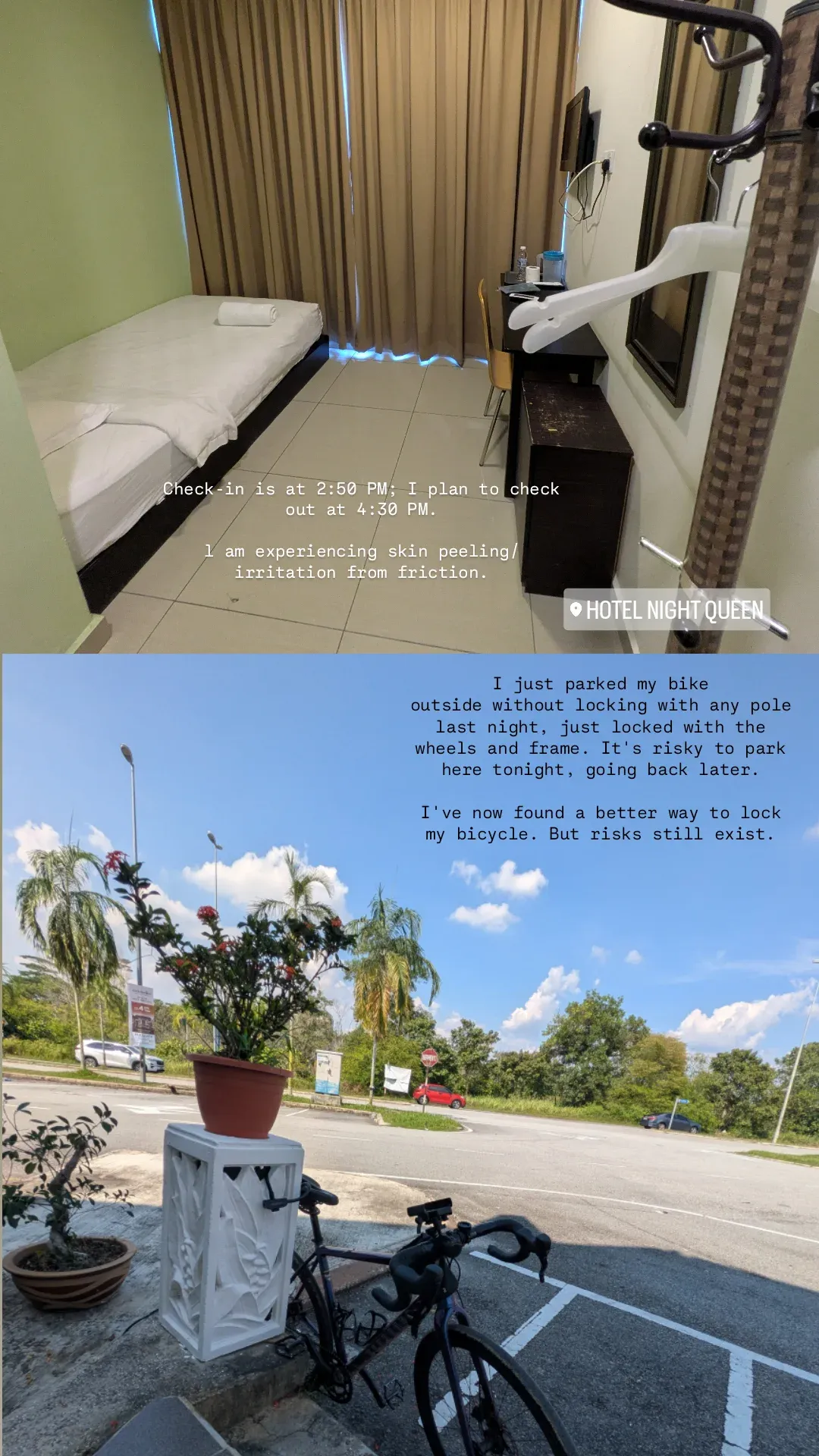
- The Check-In Fiasco: Battered by friction skin irritation and desperate for a shower, I booked a hotel room online, assuming “same-day check-in” meant immediate access. Arriving at the desk, I was met with a strict 2:00 PM check-in policy at a fully booked hotel. Eventually, I found a room at Hotel Night Queen, collapsing for a brief 1.5-hour power nap between 2:50 PM and 4:30 PM.
- Bike Security Paranoia: Having no heavy lock, I had to lock the gravel bike through its frame and wheels outside open public spots—staring out the window every few minutes to ensure it wasn’t being loaded into a van.
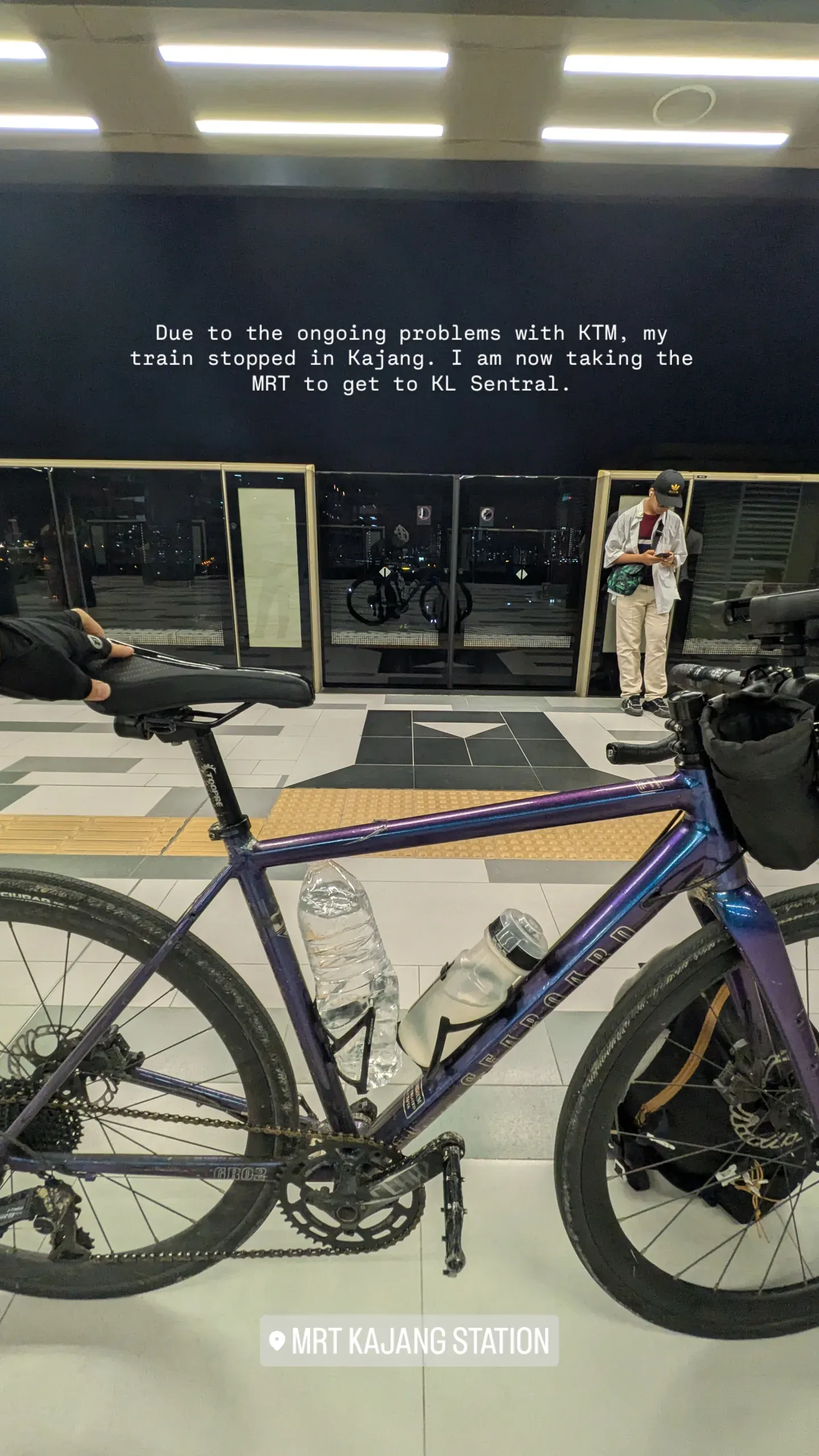
- The Train Breakdown Commute: Planning to catch a direct KTM train home to Klang, I was hit with major service disruptions. I had to detour to Kajang, manually haul my heavy bike up steep station staircases, and board the MRT line toward KL Sentral before finally reaching home.
🌠 8. Final Reflection: Where Is the Limit?
From my early trial at Fraser’s Hill to bouncing back from a snapped shifter on my first 300 km attempt, surviving a high-speed night crash, navigating active flood zones, and conquering 300 km of pitch-black roads, this journey proved what I set out to test:
You don’t need elite gear to achieve extraordinary endurance milestones.
When you strip away the carbon frames, the custom apparel, and the safety net of a support crew, all that remains is your relationship with pain and your willingness to keep turning the pedals.
If you were to strip away all these negative variables—if I didn’t have to haul a 4 kg weighted backpack on my spine; if I didn’t have to worry about running out of food and water; if I didn’t have to ride in constant fear of hidden road hazards in the dark and floodwaters; and if you handed me a top-tier carbon road bike, a dedicated support vehicle trailing behind, and seamless roadside logistics—
I am absolute in my conviction that I could have pushed straight through to 500 kilometers that very same day.
Ultimately, this ride was a mental experiment—a deliberate act of extreme self-restriction and physical stripping to crown the final chapter of my twenties. It stands as my absolute final ultra-endurance challenge of this decade. Starting in 2026, I am stepping back and capping my rides strictly to a maximum of 30 km a day.
From the climbs of Fraser’s Hill to the redemption of this 300 km loop, this journey proved what mattered most: it is never the limit of physical endurance that holds us back, but the constraints of our environment and mind. As long as the fire inside refuses to burn out, these legs will keep carrying me further into whichever chapter comes next.
The Twenties Milestone Series
- Chapter 1 (The Crucible): Pitch Black Detours and 2,000m+ Climbs: How I Conquered Fraser’s Hill Solo
- Chapter 2 (The Graduation Badge): 300km in 24 Hours — My Malaysia Ultra Solo Ride Record in Casual Gear (You are here)